Access to capital is essential for starting and growing a business. But not every entrepreneur can secure financing from a traditional bank, and not every business is a good fit for angel investment or venture capital.
That’s why a healthy entrepreneurial ecosystem needs a variety of capital providers, each serving different needs. Among them are Community Development Financial Institutions (CDFIs), which play an important but often overlooked role in helping entrepreneurs succeed.
Filling Gaps in Small Business Financing
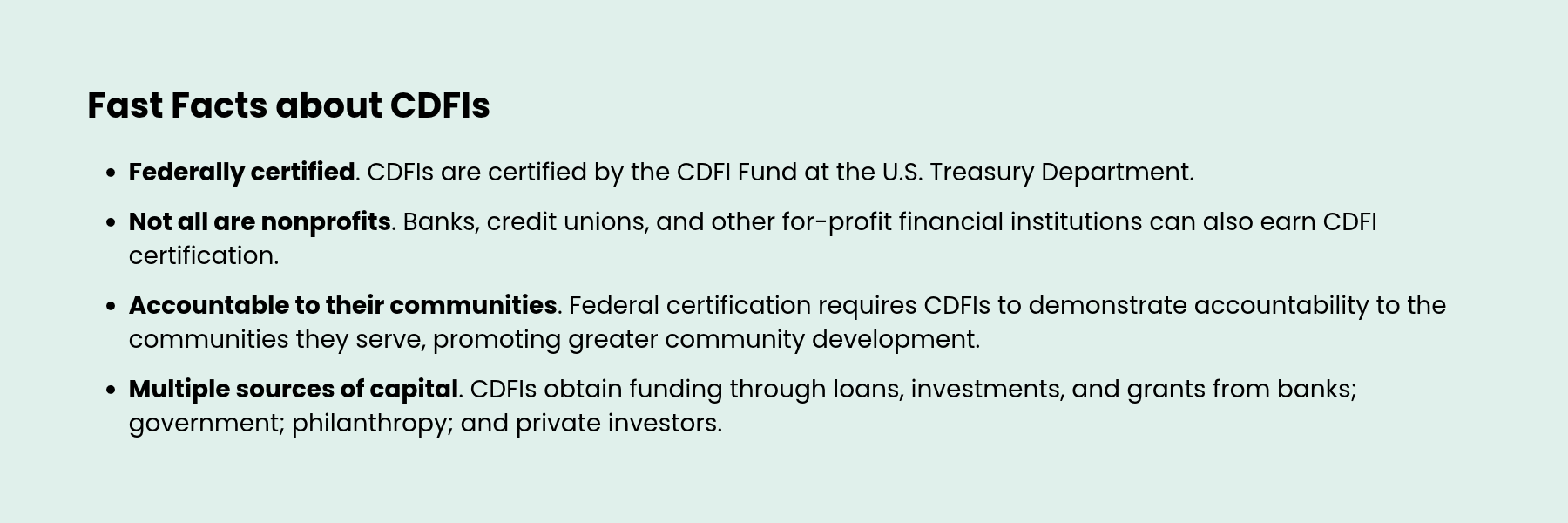
CDFIs are mission-driven financial institutions that provide financing and other support to individuals and businesses underserved by conventional lenders. They help close financing gaps not only by making capital available to businesses that might otherwise go without, but also by providing fair, affordable alternatives to high-cost or even predatory lending.
Consider a few examples:
A startup without the operating history needed to qualify for a conventional bank loan.
A neighborhood business seeking a loan too small to be attractive to many banks.
An entrepreneur with limited collateral or a thin credit history.
A rural small business with few local financing options.
CDFIs help businesses like these access financing on terms that support their growth. They cite flexible underwriting standards, expanded access to financial products, and loan terms as the most valuable contributions they offer clients.
And not to be overlooked, many CDFIs also provide business support services, including business coaching, financial planning, and other assistance that help entrepreneurs improve their financial literacy and put financing to productive use.
This combination of capital and knowledge can help more businesses gain traction and build a foundation for long-term success.
Partners, Not Competitors
CDFIs and traditional banks are often complementary rather than competitive.
Banks may refer prospective borrowers who don’t meet their lending criteria to CDFIs. CDFIs, in turn, can help entrepreneurs strengthen their businesses, establish credit histories, and build track records that will make them attractive customers to banks.
Banks also provide capital to CDFIs, sometimes receiving Community Reinvestment Act (CRA) credit for those investments or loans. In some cases, banks and CDFIs participate in financing the same business.
These relationships extend the reach of small business financing, helping more entrepreneurs find the capital and support they need.
The Opportunity for Missouri
CDFIs already make a meaningful contribution to Missouri’s economy. According to the U.S. Treasury Department, between 2005 and 2023, CDFIs financed 15,710 Missouri small and microbusinesses, helping create or retain more than 31,000 jobs.
Yet Missouri has considerable room to expand CDFI lending. According to CDFI Friendly America, during that same period CDFI small business and microbusiness lending per capita totaled just $146 in Missouri, compared with $246 in neighboring Tennessee and $337 in Iowa.
Demand for CDFI financing and services is also growing. According to the Federal Reserve’s 2025 CDFI Survey, 71% of CDFIs nationwide reported increased demand in 2024. At the same time, 63% identified lending capital as a factor limiting their ability to meet that demand.
Greater access to affordable capital would allow CDFIs to serve more entrepreneurs, particularly those who struggle to secure conventional financing or face costly alternatives.
A healthy entrepreneurial ecosystem depends on a variety of capital providers working together to meet the diverse financing needs of businesses. When CDFIs are strong, fewer entrepreneurs and viable small businesses fall through the cracks. Instead, they gain access to the capital and support they need to grow, create jobs, and contribute to stronger communities across Missouri.